


When Your Older AC Struggles Against the Summer Peak
Your older air conditioning system is running continuously, yet the living room still feels sticky, warm, and distinctly uncomfortable. If you are dealing with this frustrating scenario, exploring the process of upgrading to a High-Efficiency AC: A Look at SEER2 Ratings in Action is the first step toward real relief. A struggling system does more than just rack up high utility bills; it fails to manage the heavy moisture and intense temperatures that define our local climate. Upgrading to modern cooling standards is about much more than just swapping out old parts. It is about fundamentally improving how your entire home handles the severe weather outside.
To learn more about your options for dependable cooling, explore our comprehensive services for HVAC systems.
During July peak heat and humidity, your cooling equipment faces a dual challenge. It must handle sensible heat, which is the actual temperature reading on your thermostat, and latent heat, which represents the heavy moisture hanging in the air. Older units often manage the temperature but completely fail at moisture removal, leaving your home feeling like a damp cave. Understanding modern efficiency metrics empowers you to choose a system that tackles both heat and humidity effectively, providing long-term comfort and relief.
Signs your aging system is losing the battle:
• Constant operation: The unit runs for hours without ever cycling off, struggling to reach the set temperature.
• Clammy indoor air: The air coming from your vents feels cool, but your skin still feels sticky due to high indoor humidity.
• Uneven cooling: Certain rooms remain stubbornly hot while the hallway near the thermostat feels freezing.
• Escalating energy consumption: Your monthly utility usage spikes dramatically as the system draws more power to compensate for worn-out components.
Beyond the Basics: What the SEER2 Shift Means for Homeowners
When you start researching new cooling equipment, you will immediately encounter the term SEER2. SEER stands for Seasonal Energy Efficiency Ratio, and it essentially acts as the miles-per-gallon rating for your air conditioner. The higher the number, the more cooling output you receive for the electrical energy consumed. However, the HVAC industry recently underwent a massive shift. In 2023, the Department of Energy (DOE) updated their testing procedures, moving from the old SEER metric to the new, more rigorous SEER2 standard.
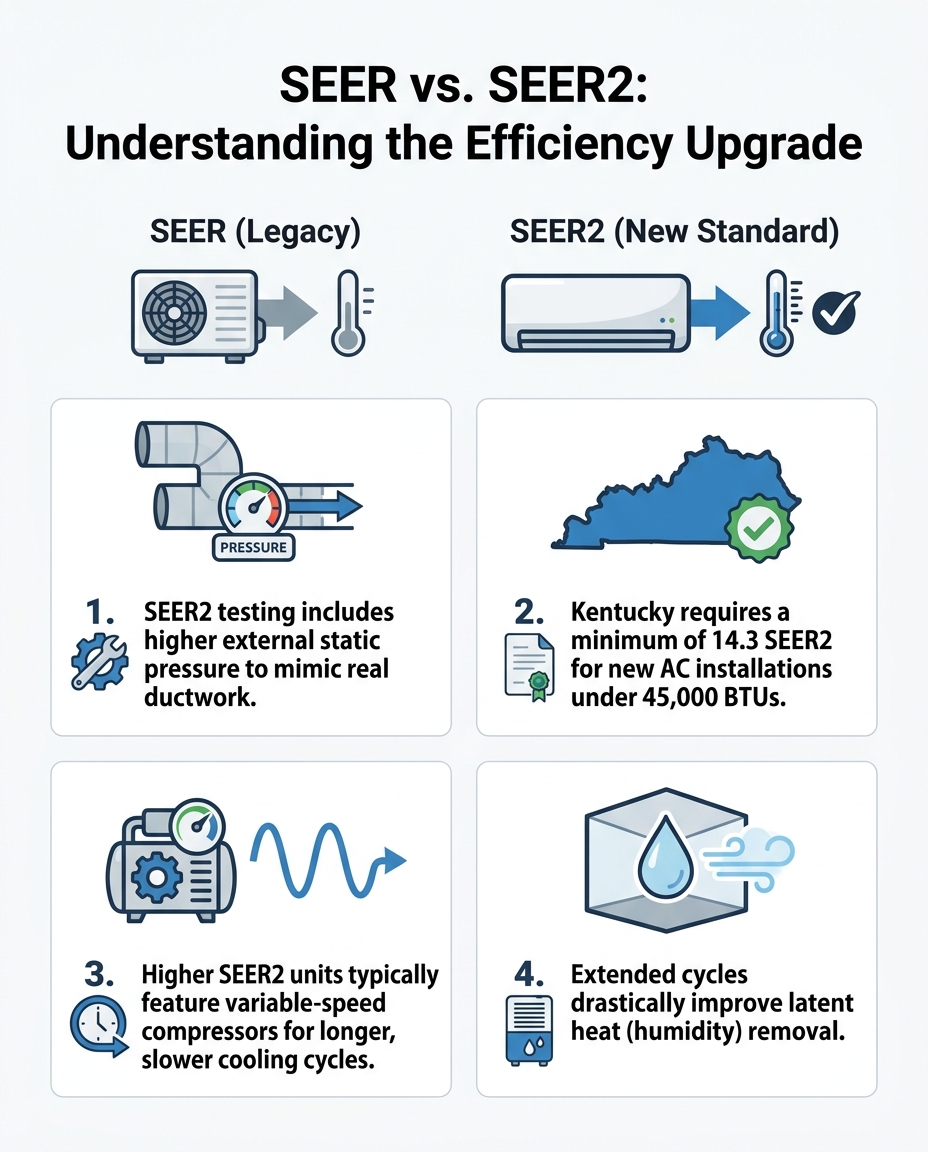
This transition is highly relevant for residents in Fairdale KY and the surrounding areas because our region falls into the DOE's Southeastern zone. In this climate zone, the federal government mandates a minimum rating of 14.3 SEER2 for new residential cooling installations under 45,000 BTUs. Understanding this baseline helps you evaluate whether investing in high-efficiency air conditioning makes sense for your long-term comfort goals.
Real-World Ductwork vs. Laboratory Testing
The problem with the old standard: For decades, the original SEER testing happened in highly controlled laboratory environments. These tests did not account for the intense resistance that air faces when pushed through the typical ductwork found in an average home. As a result, a unit rated at 16 SEER in a lab might perform at a much lower efficiency level once installed in a real house with bends, restrictions, and long duct runs.
The SEER2 solution: The new testing protocols introduce significantly higher external static pressure to accurately mimic real-world ductwork conditions. This means that a SEER2 rating provides a much more accurate expectation of how the equipment will actually perform in your home. When you purchase a system based on its SEER2 rating, you can trust that it has been tested against the genuine airflow restrictions it will face while keeping your family cool.

Tackling the Heavy Latent Heat Load of a Subtropical Climate
In a humid subtropical environment, the temperature on the thermometer only tells half the story. The heavy moisture content in the air makes the heat feel significantly more oppressive. This is where high-efficiency SEER2 units truly separate themselves from builder-grade equipment. To understand why, you have to look at the difference between sensible cooling and latent cooling.
Sensible cooling is the process of dropping the actual air temperature. Latent cooling is the process of extracting water vapor from the indoor air. During July peak heat and humidity, moisture removal is just as critical as temperature reduction. If your system only drops the temperature without pulling out the humidity, your home will feel uncomfortably cold and clammy.
High-efficiency SEER2 systems are specifically engineered to excel at latent cooling. By managing the heavy latent heat load of our humid Kentucky summer environment, these systems lower the indoor humidity level. Because drier air allows your body to cool itself more effectively, you will actually feel cooler at a higher thermostat setting. You might find that 74 degrees with low humidity feels far more comfortable than 70 degrees with high humidity.
• Cooling Style — Older / Low-Efficiency Units: Rapid, short blasts of cold air — High-Efficiency SEER2 Units: Steady, consistent temperature management
• Moisture Removal — Older / Low-Efficiency Units: Poor; often leaves air feeling clammy — High-Efficiency SEER2 Units: Excellent; extracts heavy indoor humidity
• Comfort Level — Older / Low-Efficiency Units: Frequent temperature swings — High-Efficiency SEER2 Units: Even, balanced comfort throughout the home
Variable-Speed Cooling: Why Longer Cycles Improve Indoor Air Quality
The secret behind the superior humidity control of a high SEER2 unit lies in the compressor technology. Traditional, single-stage air conditioners operate on a very basic principle: they are either 100% on or 100% off. When the thermostat calls for cooling, a single-stage unit blasts cold air at maximum capacity until the target temperature is reached, and then it shuts down completely. This creates noticeable temperature swings and limits the amount of time air spends passing over the cold evaporator coil.
In contrast, modern high-efficiency systems frequently utilize variable-speed technology. A variable-speed compressor can adjust its output in tiny increments, running at lower capacities for much longer durations. Instead of blasting cold air and shutting off, the system gently circulates air continuously. This is an important factor to consider if you are wondering whether it is cheaper to leave your AC running all day, as variable-speed units are designed for long, low-power operation.
The benefits of longer, slower cooling cycles include:
• Maximum dehumidification: Because the air is constantly moving over the cold indoor coil, the system pulls significantly more moisture out of your living space.
• Lower energy consumption: Running steadily at a low speed uses far less electricity than constantly starting and stopping a heavy motor.
• Enhanced indoor air quality: Continuous air circulation means your home's air is constantly passing through the HVAC filter, trapping more dust, dander, and airborne particles.
• Consistent temperatures: Variable-speed systems eliminate the hot and cold spots that plague homes in Fairdale KY by keeping the conditioned air mixed evenly.
Recognizing the Tipping Point for an Equipment Upgrade
Deciding when to replace an aging air conditioner is a common challenge for homeowners. It often feels easier to just pay for another minor repair and hope the system survives the season. However, forcing an old, struggling unit to operate continuously during severe heatwaves places immense stress on failing components. Eventually, a minor issue cascades into a major breakdown, leaving your family stranded without cooling right when you need it most.
The tipping point: You know it is time to consider an upgrade when your system requires frequent repairs, struggles to maintain the thermostat setting, or causes your energy consumption to skyrocket under heavy load. One Fairdale KY homeowner recently reached out because their AC was simply not working during a stretch of severely hot weather. A technician arrived within hours, diagnosed the failing components, and clearly explained the underlying issues. By understanding exactly why the old system was failing, the homeowner was able to make an informed decision to resolve the problem efficiently and understandably.
Shifting your mindset from "fixing a broken part" to "investing in whole-home climate control" changes the equation. A reliable, modern SEER2 system provides the reassurance that your equipment can accurately manage peak cooling demands without sudden failures. You gain a quieter home, lower monthly energy usage, and a significantly more comfortable indoor environment.
Targeted Cooling Options for Persistent Hot Spots
Even with a highly efficient central air conditioner, some homes have specific architectural challenges that make uniform cooling difficult. Sunrooms, converted garages, upper-level master suites, or historic homes with limited ductwork often remain stubbornly hot. If your central system is working perfectly but a specific room is still uncomfortable, you do not necessarily need to replace your entire HVAC setup.
Ductless technology offers a brilliant, high-SEER2 alternative for these persistent hot spots. Also known as ductless mini-split systems, these units provide direct, zoned cooling exactly where you need it, without requiring any new ductwork. They consist of a small outdoor compressor and a sleek indoor air handler mounted high on the wall. Because they bypass ductwork entirely, they operate at incredibly high efficiency levels.
Another local family recently needed a new furnace and air conditioning unit to resolve severe comfort issues in their home. The installation team assessed the layout, matched the right equipment to the space, and installed the new units quicker than estimated, restoring comfort efficiently. Combining a central high-efficiency system with targeted ductless units creates comprehensive, customized comfort for every square foot of your home during July peak heat and humidity.
Navigating Generic Tax Credits and Accessible Upgrade Paths
One of the most common concerns about upgrading to a high-efficiency SEER2 system is the initial investment. However, choosing premium equipment often opens the door to significant financial incentives that make the transition much more manageable. Under current federal energy initiatives, highly efficient cooling systems and heat pumps frequently qualify for generic energy tax credits. Additionally, many local utility providers offer rebate programs to encourage homeowners to reduce their demand on the power grid during peak summer months.
We always advise homeowners to consult with their local utility providers or a qualified tax professional to verify which current incentive programs apply to their specific installation. Beyond these incentives, the long-term reduction in your monthly energy consumption helps offset the initial investment over the lifespan of the equipment. A system that uses less electricity day in and day out pays dividends every summer.
Furthermore, working with a professional team means you have access to flexible HVAC financing plans. These accessible options allow you to step up to a higher efficiency tier without draining your savings, breaking the project down into manageable monthly arrangements. This ensures that premium comfort and superior humidity control in Fairdale KY are well within reach for the average household.
Make an Informed Decision for Long-Term Home Comfort
Upgrading your cooling equipment is a significant decision, but understanding the metrics makes the process straightforward. A higher SEER2 rating translates directly to better humidity control, advanced variable-speed technology, and highly efficient energy management. By matching the right technology to the specific demands of our heavy latent heat load, you ensure your home remains a cool, dry sanctuary all summer long.
We encourage you to explore your options and evaluate your current system's performance before a complete failure forces a rushed decision. Taking the time to research high-efficiency solutions during July peak heat and humidity empowers you to make a choice that enhances your family's comfort, improves your indoor air quality, and provides lasting reliability for years to come.
Frequently Asked Questions
What is a good SEER2 rating for a hot, humid climate?
In a hot and humid environment, a rating of 15 to 18 SEER2 is generally considered excellent for balancing strong performance with energy reduction. Systems in this range frequently feature two-stage or variable-speed compressors, which are highly effective at pulling moisture out of the air. This superior dehumidification is critical for staying comfortable when the outdoor humidity spikes.
Is a 16 SEER2 considered highly efficient?
Yes, a 16 SEER2 system is considered highly efficient and represents a significant upgrade over older builder-grade units. This rating comfortably exceeds the federal minimum requirements and utilizes advanced technology to manage both temperature and humidity. Homeowners upgrading from an older 10 or 12 SEER unit to a 16 SEER2 model typically notice a dramatic improvement in their indoor comfort.
What is the exact difference between SEER and SEER2?
The primary difference lies in how the equipment is tested for efficiency. The newer SEER2 testing protocols apply much higher external static pressure to mimic the actual airflow resistance found in typical home ductwork. This means a SEER2 rating gives you a much more accurate and realistic expectation of how the air conditioner will perform once installed in your house.
Does a higher SEER2 rating mean better cooling and dehumidification?
Absolutely, because higher SEER2 ratings are usually achieved by using variable-speed or multi-stage compressors rather than single-stage motors. These advanced compressors run longer, slower cycles that constantly circulate indoor air over the cold evaporator coil. This continuous movement extracts significantly more water vapor from the air, resulting in superior dehumidification and a cooler-feeling home.
What does SEER2 mean for my monthly energy consumption?
A higher SEER2 rating indicates that the system requires less electrical energy to produce the same amount of cooling output as a lower-rated unit. By operating more efficiently, especially under heavy summer loads, the system reduces the overall draw on your home's electrical panel. Over time, this optimized operation leads to a noticeable reduction in the energy required to keep your home comfortable.
What is the minimum SEER2 rating required in Kentucky for new installations?
Because Kentucky is located in the Department of Energy's Southeastern region, the federal minimum requirement is 14.3 SEER2 for new residential air conditioning installations under 45,000 BTUs. Any new central cooling equipment installed must meet or exceed this baseline standard. Choosing a unit that goes above this minimum will yield even better moisture control and energy management.