

Surviving Peak Summer: When a Breakdown Forces a Major AC Decision
Before the first major heatwave hits, most homeowners don't give their cooling system a second thought. But when your system fails during peak July heat and humidity, you are suddenly forced into a high-stakes choice. Navigating the debate of Repair vs. Replace: Making the Call on a 12-Year-Old AC in Peak Summer requires stepping back from the immediate panic of a hot house and looking at the long-term financial reality of your equipment.
If you are ready to stop throwing money at an aging system, exploring air conditioning replacement is the most reliable path to restoring your home's comfort.
The immediate stress of a breakdown: Losing your cooling capacity when temperatures peak is incredibly frustrating. The house heats up quickly, sleeping becomes impossible, and the urge to authorize whatever quick fix gets the cold air blowing again is strong. However, treating a major breakdown on a decade-plus-old system as just another emergency repair often leads to a cycle of escalating costs.
Looking at total cost of ownership: This is a decision that extends far beyond the immediate service call. Sinking money into an aging unit might provide temporary relief, but it does nothing to reset the clock on the equipment's lifespan. By evaluating the system objectively, you can weigh the diminishing returns of keeping obsolete technology on life support against the guaranteed performance, energy efficiency, and peace of mind that comes with investing in modern reliability. Professional services exist to help you evaluate your system's true condition, giving you the data you need to make a confident, financially sound choice.
The R-410A Reality Check: Why Refrigerant Changes Matter
The Problem: A significant portion of AC breakdowns on older systems trace back to refrigerant leaks. If you own a 12-year-old R-410A AC unit, a leak is no longer just a standard maintenance issue—it is a major financial liability tied directly to shifting federal regulations.
The Cause: The Environmental Protection Agency (EPA), through the AIM Act, has mandated an 85% phasedown in the production and consumption of hydrofluorocarbons (HFCs) like R-410A by the year 2036. This phasedown is actively restricting the supply of the exact refrigerant your older system requires to operate. As the supply of R-410A dwindles across the industry, the cost to acquire it naturally increases. Because air conditioning systems are closed loops, needing a "top-off" means there is a physical leak in the coils or lines. Recharging the system without replacing the leaking component means that expensive, increasingly scarce refrigerant is simply going to leak out again.
The Solution: Contrasting the temporary nature of a refrigerant top-off with the long-term stability of a modern system upgrade reveals a stark difference in value. Modern cooling systems utilize updated, environmentally compliant refrigerants that are not subject to the same aggressive phasedown schedules. Investing heavily to patch and refill an obsolete system offers a rapidly diminishing return. Transitioning to a new system eliminates the R-410A dependency entirely, ensuring that you are not left vulnerable to future supply chain shortages and escalating maintenance costs.
Dehumidification Demands During Kentucky's Hottest Months
True indoor comfort requires more than just lowering the temperature on the thermostat; it requires active, continuous moisture removal. The relationship between cooling and dehumidification is the core of how your HVAC system operates. As warm indoor air passes over the cold evaporator coil, moisture condenses and drains away, leaving the conditioned air both cooler and drier.
The severe impact of July humidity in the Fairdale KY area forces older systems to run constantly, accelerating catastrophic failure and often failing to dehumidify the home properly. Aging, inefficient compressors lose their ability to maintain the consistent, prolonged cycles necessary to extract moisture effectively. Instead, a struggling 12-year-old unit might short-cycle or simply lack the cooling capacity to pull enough humidity out of the air, leaving your living spaces feeling heavy, sticky, and clammy even if the temperature reads normal.
Modern performance standards: Contrast a degraded older unit's performance with a modern SEER2 system's capabilities. Today's high-efficiency systems, particularly those with two-stage or variable-speed compressors, are specifically engineered to run at lower, more consistent capacities. This extended run time maximizes moisture removal without overcooling the space, providing a level of precise comfort that an aging, single-stage system simply cannot match.
• Humidity Control — 12-Year-Old Degraded AC Unit: Struggles to remove moisture; leaves home feeling clammy during peak summer. — Modern SEER2 Cooling System: Optimized run cycles extract maximum latent heat, keeping indoor air crisp and dry.
• Compressor Strain — 12-Year-Old Degraded AC Unit: Runs at 100% capacity constantly, accelerating wear and tear. — Modern SEER2 Cooling System: Variable or two-stage options adjust capacity dynamically to reduce mechanical stress.
• Energy Efficiency — 12-Year-Old Degraded AC Unit: Degraded coils and motors draw excessive power to achieve minimal cooling. — Modern SEER2 Cooling System: Meets updated Department of Energy standards, significantly lowering energy consumption.
Applying the Industry Age-Cost Formula to Your Cooling System
When you are staring at a broken AC during a heatwave, separating emotion from financial reality is difficult. The industry standard "5,000 rule" provides a conceptual, objective framework to help homeowners weigh repair versus replacement without getting lost in the panic of the moment.
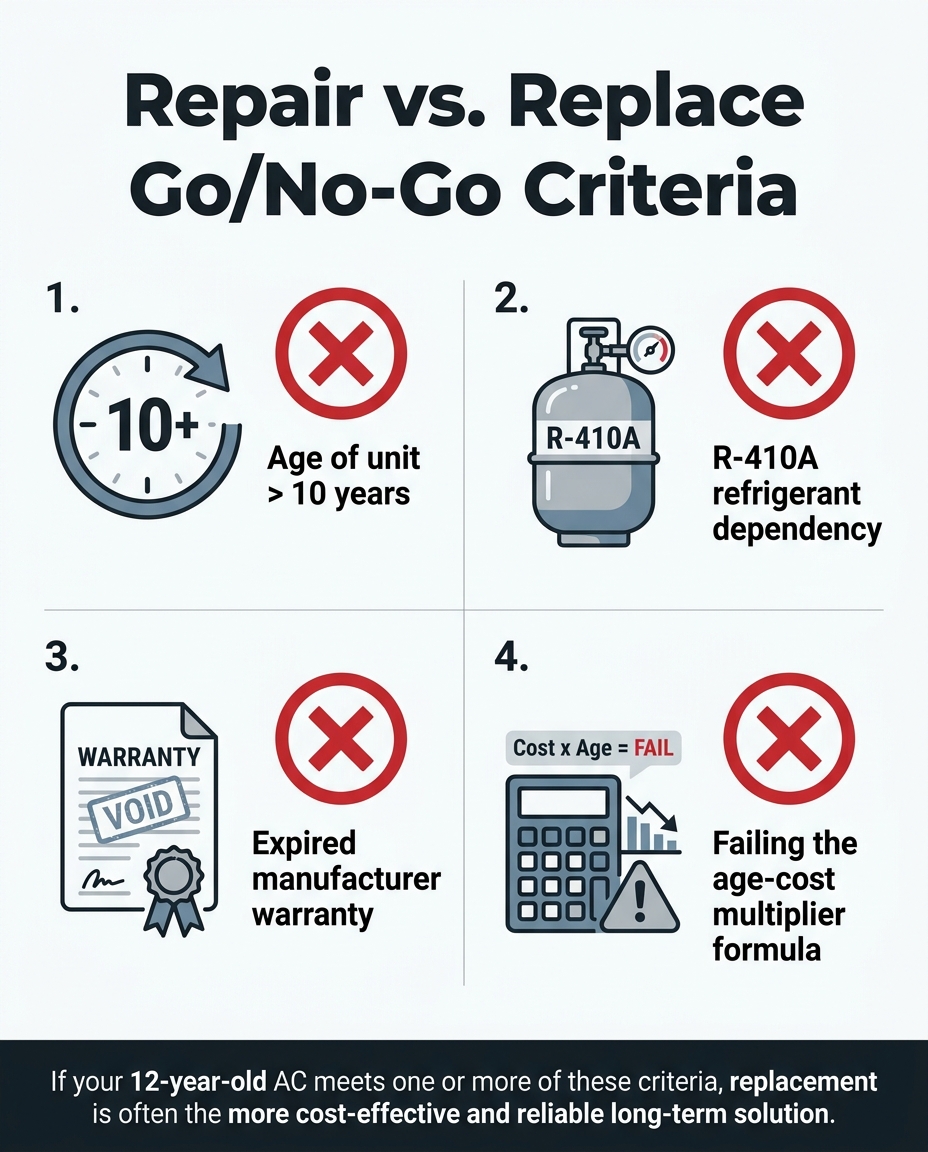
How the formula works: The calculation is straightforward. You multiply the age of your equipment in years by the estimated cost of the proposed repair. If the resulting number crosses the 5,000 threshold, replacement is almost universally the financially sound choice. For example, if you are operating a 12-year-old R-410A AC unit, even a moderate repair bill for a failing blower motor or a refrigerant leak will easily push the multiplier past that critical limit.
Why this framework matters: Crossing that threshold indicates that the system has entered the phase of its lifecycle where catastrophic component failures become highly probable. Sinking significant capital into a unit that fails this formula is akin to putting a brand-new transmission into a car with a rusted-out frame. The formula helps remove emotion from the decision-making process, replacing the desperate hope that "this will be the last repair" with a clear, mathematical indicator that it is time to upgrade.
Operating Without a Safety Net: When Warranties Expire
One of the most overlooked factors in the repair versus replace debate is the status of the manufacturer's warranty. Most standard manufacturer warranties expire squarely at the 10-year mark. When your system reaches 12 years of age, you are operating entirely without a safety net.
The risk of major component failure: At this stage in the equipment's lifespan, you are fully responsible for the cost of every major component failure. If the compressor seizes, the condenser fan motor burns out, or the evaporator coil develops a fatal leak, 100% of the parts and labor costs come directly out of your pocket. Continuous operation during peak July heat and humidity places maximum strain on these unprotected, aging parts. A system that has been baking in the sun and running non-stop for over a decade is a prime candidate for a sudden, expensive breakdown.
Efficiency and energy usage: Beyond the risk of repair bills, there are common concerns regarding energy usage on older systems that are forced to run constantly just to keep up. Homeowners often wonder is it cheaper to leave the AC on all day, but when dealing with a degraded, out-of-warranty unit, constant operation simply accelerates mechanical wear while driving up utility costs. An expired warranty means you are paying a premium in energy to operate a system that could require a massive out-of-pocket repair at any moment.
Turning an Emergency Expense into a Manageable Monthly Investment
The primary reason homeowners hesitate to replace a failing system is the anticipated sticker shock. A sudden HVAC replacement is rarely a planned expense, and the prospect of parting with a large lump sum of cash during a stressful breakdown can drive people toward opting for a cheaper, temporary repair instead.
The power of financing: Reframing the expense changes the entire equation. Utilizing flexible HVAC financing options transforms a lump-sum panic into a predictable, manageable monthly investment. Rather than draining savings to patch an obsolete unit, financing allows you to preserve your capital while immediately upgrading to a highly efficient, reliable system.
Offsetting the monthly cost: It is also crucial to factor in the operational savings. A modern SEER2 system operates with significantly higher efficiency than a 12-year-old degraded unit. The month-over-month energy savings generated by the new system can actually help offset a portion of the monthly financing costs, making the transition far more budget-friendly than it initially appears.
Maximizing Current Installation Incentives
To further alleviate the financial burden, timing your replacement to take advantage of ongoing promotions maximizes your overall value. By combining competitive financing rates with current installation specials, you can often secure a premium system at a highly accessible price point. This strategic approach not only resolves the immediate cooling crisis but also secures the long-term financial security of a brand-new, comprehensive manufacturer warranty.
Checklist: Clear Signs It Is Time to Upgrade Your Cooling System
When you find yourself constantly searching for "ac repair near me" just to keep your home habitable, it is time to transition from seeking temporary fixes to planning a permanent upgrade. Use this objective checklist to determine if your system has reached the end of its viable lifespan:
• Age and Refrigerant Type: The system is over 10 years old and relies on the phased-out R-410A refrigerant.
• Failing the Multiplier: The estimated repair cost, when multiplied by the age of the unit, exceeds the conceptual limits of the industry age-cost formula.
• Lack of Protection: The original 10-year manufacturer warranty has officially expired, leaving major, expensive components completely unprotected.
• Poor Climate Control: The system struggles to maintain basic comfort and fails to provide adequate humidity control during high summer heat, leaving the house feeling damp.
• Rising Operational Costs: You notice a steady, unexplained increase in your monthly energy bills despite the system running constantly.
Make the Right Call for Your Home's Comfort and Budget
Navigating an AC breakdown during July heat and humidity is stressful, but making the right long-term choice doesn't have to be. Investing further into obsolete technology and dwindling refrigerant supplies offers rapidly diminishing returns. By applying a clear financial framework—weighing the age of the unit, the status of the warranty, and the benefits of modern efficiency—you can make the smartest decision for your home.
You do not have to settle for a home that feels sticky and uncomfortable while paying a premium in repair and energy costs. Schedule a professional evaluation with a trusted provider of comprehensive HVAC services to discuss your upgrading options. Secure reliable, energy-efficient comfort before the next major heatwave hits, and enjoy the peace of mind that comes with a brand-new, fully warrantied cooling system.
Frequently Asked Questions
Is it worth fixing a 12 year old AC?
In most cases, sinking significant money into a 12-year-old AC is not recommended. At this age, the system has outlived its manufacturer warranty and is likely experiencing degraded efficiency. Applying the industry age-cost formula usually reveals that investing the repair money into a new, reliable system offers a much better long-term return.
How does the R410A phase out affect my AC repair?
The EPA's phasedown of R-410A means the supply of this specific refrigerant is shrinking, driving up the cost of recharges. If your older system has a leak, topping it off with R-410A is an increasingly expensive band-aid. Transitioning to a new system utilizes modern, compliant refrigerants, protecting you from these escalating supply chain costs.
Should I repair or replace my AC in the summer?
Replacing an aging, failing AC during the summer is often the best choice to avoid prolonged discomfort and repeated emergency service fees. While a quick repair might seem appealing in the moment, summer heat places maximum strain on older units, making secondary breakdowns highly likely. Upgrading immediately secures reliable cooling when you need it most.
What is the 5000 rule for air conditioners?
The 5,000 rule is a conceptual formula used to objectively weigh the financial viability of a repair. You multiply the age of your AC unit by the estimated cost of the repair; if the total exceeds 5,000, industry standards suggest that replacing the unit is the wiser financial decision. This helps homeowners avoid throwing money at a system nearing the end of its life.
How long does an AC unit typically last?
A standard central air conditioning unit typically lasts between 10 and 15 years, depending on maintenance history and local climate demands. Once a unit crosses the 10-year mark, major components begin to wear out, and the original manufacturer warranty expires. Beyond this point, the likelihood of catastrophic failure increases significantly.
Will a new AC unit improve my home's humidity control?
Yes, a modern AC unit will drastically improve your home's humidity control compared to an older, degraded system. New SEER2 systems, especially those with variable-speed technology, run longer, more consistent cycles at lower capacities. This extended operation extracts significantly more latent moisture from the air, eliminating that clammy feeling and maximizing indoor comfort.