

When the Heat Hits the Roof: Understanding Your Commercial AC's Limits
If you are wondering why your Louisville commercial AC struggles during the July heatwave (and how to fix it), the answer often starts with a startling statistic: commercial rooftops can reach temperatures 40 to 50 degrees hotter than the ambient ground temperature. You hear your rooftop units (RTUs) running continuously all afternoon, yet the indoor temperature refuses to drop. Your employees are uncomfortable, and as a facility manager, you face a critical decision. Do you have a broken system that requires an immediate emergency repair, or is your equipment simply operating at its maximum design limit due to the severe weather? At One Choice Mechanical, our team fields calls every summer from businesses in Fairdale and the greater Louisville area facing this exact scenario.
During a typical July Heatwave, high-pressure systems frequently trap heat and humidity across the Ohio Valley. This creates a dome of stagnant, sweltering air that punishes mechanical equipment. When the sun beats down on a flat commercial roof, the solar heat gain turns that space into an oven. Your air conditioning system is forced to pull in this superheated air and attempt to dump the building's heat into it—a task that defies the basic laws of thermodynamics when the outside air is already boiling.
This guide sets out to clarify exactly what happens to your commercial cooling system when the weather pushes it to the brink. By the end, you will understand how to distinguish between a mechanical failure that requires a technician and an environmental overload that just requires patience and smart triage.
Need expert help right now? Learn more about our commercial HVAC services or request an inspection for commercial AC repair today.
The 95-Degree Threshold: How ASHRAE Design Limits Impact Cooling
To understand why your building feels warm on the hottest days, you have to look at how commercial cooling systems are engineered. Standard commercial HVAC systems are designed following guidelines from ASHRAE (the American Society of Heating, Refrigerating and Air-Conditioning Engineers). In most regions, these systems are engineered to maintain a comfortable 75°F indoor climate when the outdoor temperature is exactly 95°F. That 95-degree mark is the magic number for peak efficiency.
When you face ambient temperatures exceeding 95 degrees, the physical capabilities of your equipment begin to drop. For every single degree the temperature rises above that 95-degree threshold, your air conditioning system loses roughly 1% to 2% of its total cooling capacity. If it is 100°F outside, your RTU is operating with 5% to 10% less power than it was designed to deliver. This means an AC struggling during a massive heatwave might be functioning exactly as designed, but it is simply buckling under an extreme environmental load.
This threshold becomes even more problematic for aging commercial equipment. As compressors wear down and coils degrade over the years, the system reaches its maximum capacity much faster than a brand-new model. An older unit might start losing capacity at 90°F instead of 95°F, making the afternoon heat feel even more punishing inside your facility.
Why Capacity Drops as Temperatures Rise
The science of heat transfer dictates that heat naturally moves toward cooler spaces. Your air conditioner does not actually "create" cold air; it absorbs heat from inside your building and pumps it outside. However, it is incredibly difficult to dump heat into air that is already extremely hot. When the outdoor air is scorching, the refrigerant cycle becomes highly inefficient.
Because the system struggles to release heat outdoors, the compressors are forced to work harder and run longer. This leads to continuous, non-stop operation. The system runs indefinitely because it simply lacks the physical capacity to reach the thermostat's set point under such extreme conditions.
Battling the Humidity: Sensible vs. Latent Cooling
The Problem: Your commercial rooftop unit has been running for hours, but the indoor air still feels sticky, heavy, and uncomfortably warm. Employees are complaining about the heat, yet you can hear the system operating at full blast.
The Cause: The system is trapped in a battle against extreme Ohio Valley humidity, forcing it to expend massive amounts of energy on latent cooling rather than sensible cooling. Sensible cooling is the process of actually dropping the room's temperature—the number you read on the thermostat. Latent cooling is the process of removing moisture from the air. In highly humid conditions, which we frequently see plaguing Louisville and Fairdale commercial districts, the RTU must strip the heavy moisture out of the air before it can effectively lower the sensible temperature. High humidity makes heat indexes soar well over 100°F, creating the illusion that the AC is running but not working, when it is actually just dehumidifying the space.
The Solution: You must manage the indoor moisture load to help the system transition back to sensible cooling. This means identifying and mitigating indoor moisture sources. Large groups of occupants, manufacturing processes, open warehouse doors, and unvented kitchens all pump moisture into the air, compounding the issue. By sealing the building envelope and using exhaust fans in high-moisture areas, you reduce the latent heat load, allowing the RTU to finally focus on dropping the actual temperature.
The Urban Heat Island and the Rooftop Oven Effect
The physical location of your RTU dramatically compounds the ambient temperature challenges it faces. When the weather report says it is 95°F outside, that measurement is taken in the shade, over grass, with plenty of airflow. That is not the environment where your commercial AC lives.
Most commercial buildings feature flat, dark, or highly reflective roofing materials. These surfaces absorb and radiate solar heat, creating a microclimate on your roof that is significantly hotter than the ground below. This compounding effect means that while the official weather report reads 95°F, the ambient temperature entering your RTU's condenser coils might be 130°F or higher.
Furthermore, dense Louisville commercial districts suffer from the urban heat island effect. Concrete, asphalt, and steel absorb massive amounts of heat during the day and slowly release it at night. This prevents the surrounding air from cooling down after the sun sets. When the next morning arrives, your AC starts the day at a severe disadvantage because the building's thermal mass never fully reset.
Restricted airflow on the roof also plays a major role. Parapet walls designed to hide the equipment from street view can accidentally block prevailing winds. Clustered units exhaust hot air directly into one another's intake vents. These architectural features create stagnant, superheated microclimates that push the equipment far beyond its design limits, long before the peak heat of the afternoon even arrives.
Broken vs. Maxed Out: Diagnosing Your Commercial AC
When the building is hot, the immediate reaction is often to call for emergency repairs. However, understanding the difference between a system that has mechanically failed and one that is just overloaded by ambient temperatures exceeding 95 degrees can save you from unnecessary panic and expensive emergency service fees. As the local commercial HVAC experts at One Choice Mechanical, our team wants facility managers to know exactly what they are looking at before making that call.
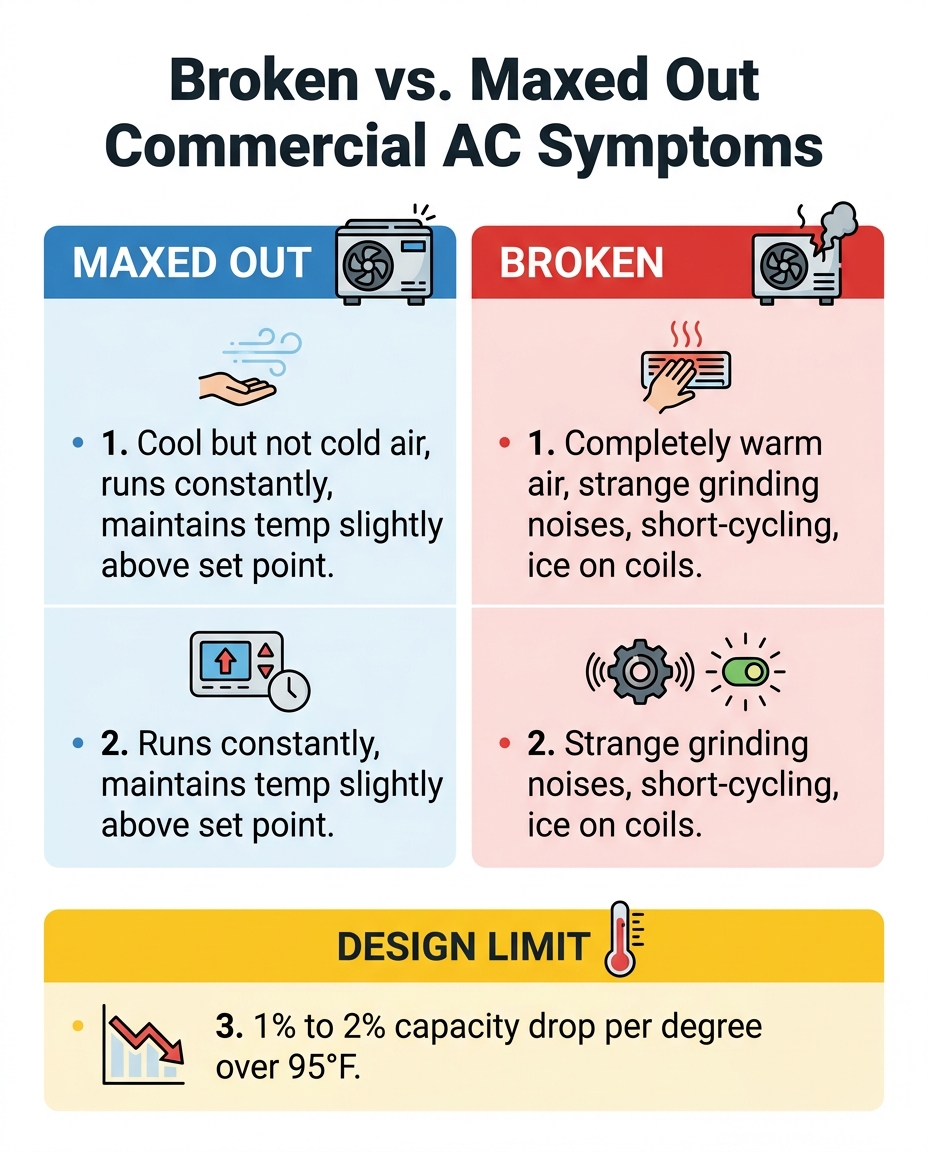
• Air Temperature at Vents — Maxed Out (Environmental Overload): Air is cool, but not cold enough to overcome the massive heat gain inside the building. — Broken (Mechanical Failure): Air is completely warm or room temperature, indicating the cooling cycle has stopped.
• System Run Time — Maxed Out (Environmental Overload): Runs constantly without stopping, struggling to reach the set point. — Broken (Mechanical Failure): Short-cycles (turns on and off rapidly every few minutes) or refuses to turn on at all.
• Indoor Temperature — Maxed Out (Environmental Overload): Maintains a temperature just a few degrees above the thermostat set point. — Broken (Mechanical Failure): Indoor temperature rises rapidly and uncontrollably throughout the day.
• System Noises — Maxed Out (Environmental Overload): Normal operational humming, just running continuously. — Broken (Mechanical Failure): Loud grinding, squealing, buzzing, or violent rattling sounds from the rooftop.
• Physical Signs — Maxed Out (Environmental Overload): Unit looks normal, just operating under heavy strain. — Broken (Mechanical Failure): Ice forming on the evaporator coils or refrigerant lines, even on a hot day.
One of the best ways to diagnose your system is to check its performance early in the morning. Before the day's peak heat sets in and the rooftop turns into an oven, your AC should be able to reach the thermostat set point. If the system cools the building perfectly at 8:00 a.m. but struggles at 4:00 p.m., it is likely maxed out by the heat. If it cannot cool the building even in the mild morning air, you have a mechanical failure that requires professional attention.
Safe, Non-Technical Triage Steps for Facility Managers
When a severe July heatwave hits the Ohio Valley, our technicians at One Choice Mechanical recommend several actionable steps you can take to mitigate the heat load inside your building. These non-technical triage steps help your system survive the afternoon without requiring you to perform dangerous DIY repairs.
• Adjusting thermostats correctly: Dropping the thermostat to 65°F will not make the system cool the building any faster. It only forces the equipment to run longer and harder, increasing the risk of a breakdown. Leave the thermostat at a reasonable setting (like 74°F or 75°F) and allow the system to work at its own pace.
• Managing internal heat loads: Close the blinds or shades on south- and west-facing windows to block direct solar heat gain. Turn off unnecessary heat-generating equipment, heavy machinery, or excess lighting during the hottest part of the day. Utilize ceiling fans to keep air circulating, which helps employees feel cooler even if the ambient temperature is slightly elevated.
• Checking the basics: Verify that your indoor air filters are not clogged with dust. A dirty filter severely restricts airflow, suffocating the system and causing the coils to freeze. Ensure that return air vents are not blocked by new office furniture, stacked inventory, or temporary displays.
• Monitoring the system: Document exactly when the system struggles. Note the time of day, the outdoor temperature, and the indoor temperature. If you do end up needing a technician, this data is incredibly useful for diagnosing whether the issue is load-based or mechanical.
When to Call a Professional
If your basic triage steps do not improve airflow, or if you notice the unit is blowing completely warm air, it is time to call a licensed technician. You can read more about the impacts of leaving the AC on all day, but you should never attempt to open rooftop unit panels yourself. Commercial RTUs involve high-voltage electricity and pressurized chemical refrigerants. Accessing the internal components requires professional certification, specialized tools, and rigorous safety training.
Proactive Measures to Protect Your RTU Before the Next Heatwave
Transitioning from immediate triage to long-term preventative strategies is the key to surviving ambient temperatures exceeding 95 degrees year after year. A pattern we see often at One Choice Mechanical is that waiting until the system fails is always more disruptive and expensive than maintaining it properly.
1. Clean the condenser coils: The most critical factor in heatwave performance is a clean condenser coil. The outdoor coil is responsible for releasing the building's heat into the outside air. When this coil is covered in dirt, pollen, exhaust soot, or cottonwood debris, that grime acts as a thick blanket of insulation. It traps the heat inside the system, severely reducing the unit's ability to dump heat outdoors and causing head pressures to skyrocket.
2. Schedule regular professional maintenance: Bring in a licensed technician before the peak summer heat arrives. They will check refrigerant levels, tighten electrical connections, inspect contactors, and ensure the blower motor is pulling the correct amperage. Preventative care catches small electrical weaknesses before they turn into catastrophic failures on a 100-degree afternoon. Ask your provider about HVAC maintenance specials to keep costs manageable.
3. Consider shading and reflective solutions: Reduce the ambient temperature immediately surrounding the RTU. Installing a reflective "cool roof" coating can drastically lower the surface temperature of the roof, reducing the thermal load on the equipment. In some cases, engineered sun shades can be installed to keep direct sunlight off the condenser coils without restricting airflow.
4. Plan for capital replacement: If your aging equipment consistently fails to meet the building's cooling demands despite clean coils and proper maintenance, it is time to plan for a replacement. Commercial HVAC systems typically last 15 to 20 years. Once they pass this threshold, the capacity loss becomes permanent, and no amount of triage will force an old unit to keep up with modern climate demands.
Keep Your Operations Running Smoothly Through the Hottest Days
Extreme heat will test the limits of any commercial air conditioning system. However, understanding those physical limits helps you manage your building's environment effectively during a brutal July Heatwave. By recognizing the difference between a system that is mechanically broken and one that is simply maxed out by the weather, you can make informed decisions that protect your equipment and your budget.
Our goal is to provide you with the actionable knowledge necessary to determine if you need to call a technician or employ simple heat-mitigation strategies. If you have run through the triage steps and suspect your system is genuinely failing rather than just struggling against the heat, do not wait for a complete breakdown.
Protect your business continuity today. Reach out to schedule a professional inspection or repair across our Louisville service areas to keep your facility comfortable all summer long.
Frequently Asked Questions
Why is my commercial AC blowing warm air during a heatwave?
If your system is blowing completely warm air, it usually indicates a mechanical failure rather than just being maxed out by the weather. The most common culprits include a failed compressor, blown fuses, or a severe refrigerant leak. While a system struggling against extreme heat will still produce cool (but not cold) air, completely warm air means the cooling process has stopped entirely. You should shut the unit down to prevent further damage and contact a licensed professional for diagnostics.
What is the maximum outside temperature for an AC unit?
Most standard commercial air conditioning units are engineered to operate efficiently up to 95°F. Once the outdoor temperature surpasses this mark, the system begins to lose about 1% to 2% of its cooling capacity for every additional degree of heat. While the unit will not immediately shut down at 96°F, it will struggle to maintain the indoor thermostat set point, resulting in continuous operation and slightly warmer indoor conditions.
How can I help my commercial AC during a heatwave?
You can help your system by reducing the heat load inside the building so the AC has less work to do. Close blinds on sun-facing windows, turn off unnecessary heat-generating machinery, and use ceiling fans to keep air moving. Additionally, ensure all air filters are clean and that no return or supply vents are blocked by furniture or inventory, which allows the system to breathe properly.
At what outside temperature does an AC stop cooling?
An AC does not have a hard shut-off temperature where it completely stops cooling, but its efficiency plummets drastically as temperatures approach 115°F to 120°F. At these extremes, the refrigerant cannot effectively release heat into the outdoor air, and the compressor may overheat and trigger a safety shut-off switch. For most regions, the system just gradually loses capacity rather than abruptly stopping, unless a safety mechanism is tripped.
Why is my commercial AC running but not cooling the building?
This often happens when the system is maxed out by high ambient temperatures or is spending all its energy removing high humidity (latent heat) instead of lowering the temperature (sensible heat). It can also be caused by severely dirty condenser coils that trap heat inside the unit, or clogged indoor air filters that restrict airflow. If checking the filters and waiting for the humidity to clear does not help, the system may be low on refrigerant.
How do dirty condenser coils affect rooftop units in extreme heat?
Dirty condenser coils act like a thick blanket wrapped around your air conditioner, trapping the heat inside the system. Because the unit cannot effectively release the building's heat into the outside air, the compressor has to work much harder, driving up internal pressures and energy consumption. During extreme heat, this added strain often causes the system to overheat and break down completely.